When your Symptoms Don’t Fit
A Systems-based approach to chronic illness
If you live with chronic illness, you may have experienced something frustrating: you have a lot of symptoms, but no single explanation seems to connect them.
Perhaps you experience fatigue, brain fog, digestive problems, headaches, dizziness, palpitations, flushing, itching, pain, or unusual sensitivity to foods and environmental triggers. You may have seen several specialists, received several diagnoses, and tried several treatments—yet you still don't feel well.
This can leave patients wondering:
“How can all of these things be happening at once?”
A systems-based approach starts with a different question:
What if some of these symptoms are connected?
From treating symptoms to understanding patterns
Conventional medical care is often organized around specialties and individual diagnoses. That structure is valuable—especially when there is a clear disease process that needs to be identified and treated.
But some chronic conditions don't fit neatly into one organ system.
The digestive system, nervous system, immune system, cardiovascular system, and musculoskeletal system don't operate independently. They constantly communicate with one another.
When several systems become dysregulated at the same time, the result can be a collection of symptoms that initially appear unrelated.
For example, one person might experience:
digestive symptoms and food sensitivities
fatigue and post-exertional worsening
dizziness or rapid heart rate when standing
headaches or sensory sensitivity
flushing, itching, or hives
widespread pain or joint instability
difficulty concentrating or “brain fog”
The goal isn't to assume that all of these symptoms have one cause.
Instead, the goal is to look for patterns and connections.
The three systems to which we pay particular attention
One useful way of understanding this pattern is through the interaction of three biological systems:
Mast cells, the nervous system, and connective tissue.
These systems communicate constantly.
Mast cells are tissue-resident immune cells that participate in immune defense and regulation. They are found throughout the body, particularly near interfaces with the external environment, and often in close proximity to nerves and blood vessels. Research increasingly shows that mast cells and sensory nerves can communicate in both directions. (Bao, 2024; Gupta, 2018)
But mast cells are only one type of immune cell.
The immune system is a much larger network involving many different cell types, including dendritic cells, eosinophils, macrophages, neutrophils, T cells, B cells, and others. Which cells become involved depends on the type of immune response and the tissues involved. The immune system also communicates with epithelial cells, blood vessels, connective tissue, and the nervous system. (Bao, 2024)
That distinction matters.
The goal isn't to assume that mast cells explain every symptom.
Rather, they provide one useful example of how immune cells, nerves, and surrounding tissues can communicate and influence one another.
Connective tissue provides structural support throughout the body, but it is also biologically active. It contains and interacts with nerves, blood vessels, immune cells, and the extracellular environment.
These aren't isolated systems.
They influence one another.
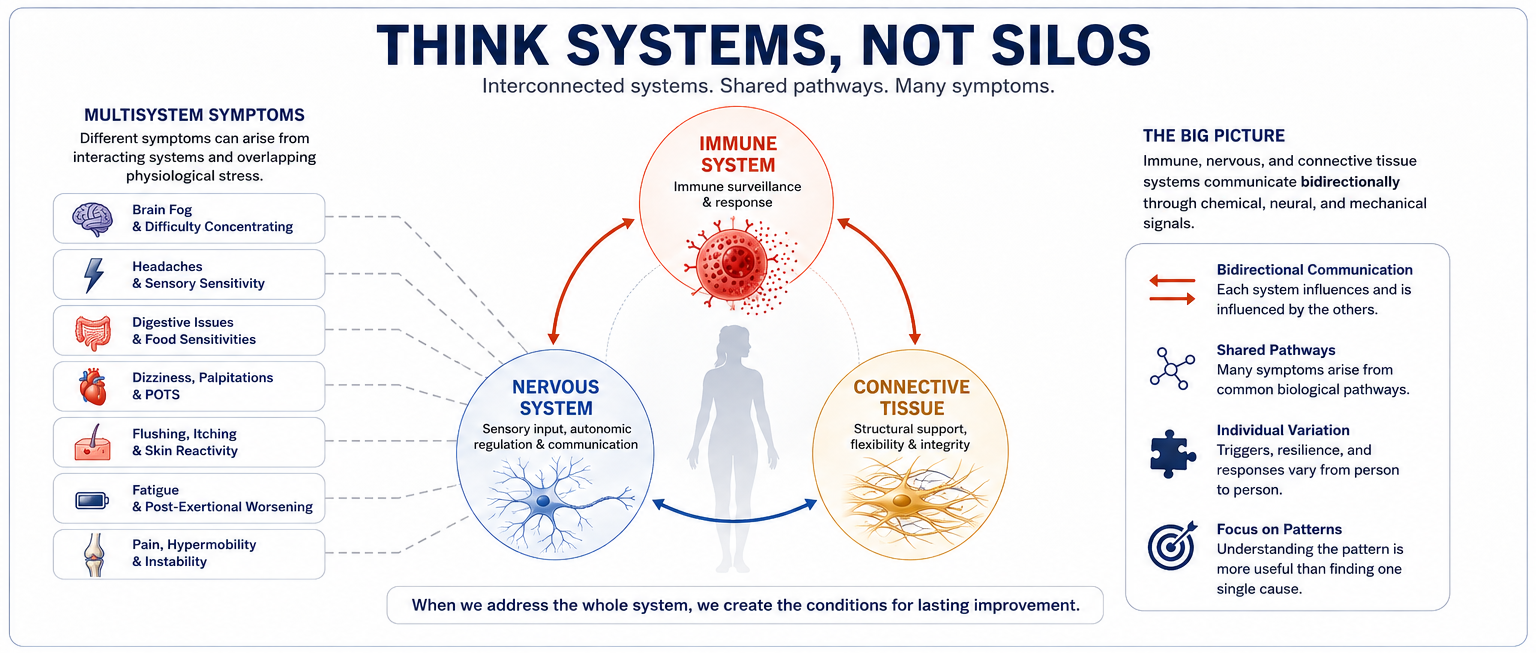
Immune, nervous, and connective tissue systems interact to influence multiple chronic illness symptoms.
Treatment begins with stabilization
One of the most important principles of this approach is:
Don't overwhelm an already overwhelmed system.
People with complex chronic illness can be unusually sensitive to changes. Something that seems relatively minor to one person may trigger a significant flare in another.
That means treatment isn't necessarily about doing more, faster.
Instead, the initial goal is often to identify factors that may be keeping the system activated and establish a more stable physiological foundation.
This can include looking at things such as:
sleep and recovery
nutrition and hydration
bowel function
environmental and dietary triggers
stress and nervous-system regulation
activity level and exercise tolerance
medication and treatment sensitivity
underlying medical conditions that may need to be addressed
The specific interventions depend on the individual. There is no single protocol that is appropriate for everyone.
Then we restore function
Once the system is more stable, treatment can become more active.
Rather than focusing exclusively on suppressing individual symptoms, the goal is to gradually improve the body's ability to regulate itself.
Depending on the person, this may involve supporting several areas at once—including immune regulation, autonomic function, gastrointestinal function, sleep, physical capacity, and musculoskeletal health.
Importantly, the order matters.
A person who is barely tolerating daily activity may need a very different starting point from someone who is relatively stable but has persistent exercise intolerance or digestive dysfunction.
The treatment plan therefore evolves over time.
The goal isn't to chase every symptom
When you have ten symptoms, it can be tempting to create ten separate treatment plans.
But if several symptoms are being generated by overlapping biological processes, treating each symptom independently may result in an increasingly complicated treatment plan without necessarily addressing the underlying dysfunction.
A systems-based approach asks:
What is driving the pattern?
What is amplifying it?
What needs to be stabilized first?
What can safely be addressed next?
And eventually:
How do we help the person regain resilience and function?
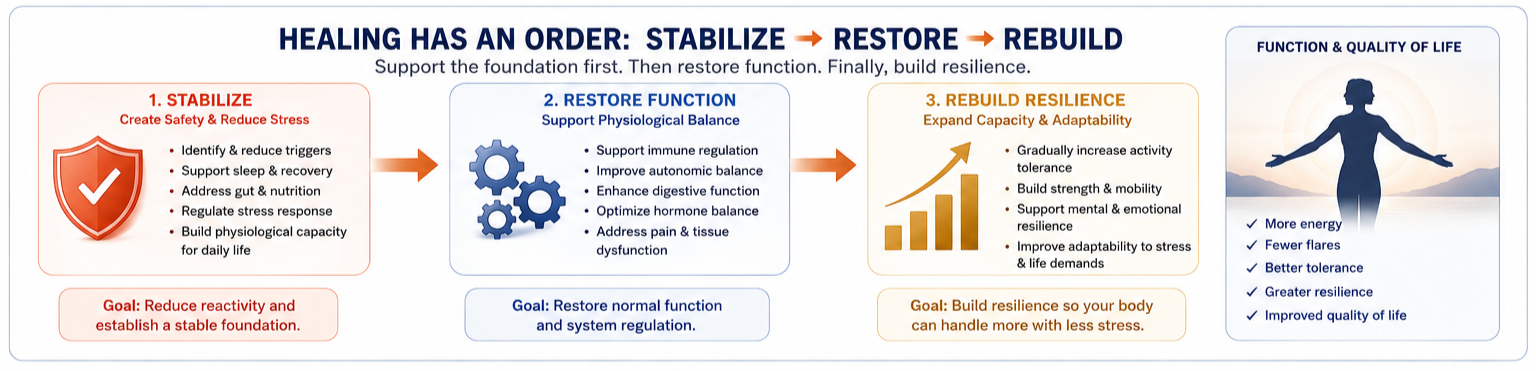
Systems-based chronic illness treatment progresses from stabilization to restored function and resilience.
Your symptoms are real—even when your tests are normal
One of the most difficult experiences for patients with complex chronic illness is being told that their testing is “normal” when they clearly don't feel normal.
Normal testing is reassuring in many circumstances, and appropriate evaluation for serious disease is always important. But not every physiological dysfunction is captured by a single laboratory test or imaging study.
The absence of an abnormal test does not automatically mean the absence of a meaningful physiological problem.
That is why history, symptom patterns, triggers, physical examination, functional changes, and the relationships between systems can be so important.
A different way of looking at chronic illness
A systems-based approach doesn't mean ignoring diagnoses.
It means putting diagnoses into context.
You can have POTS, IBS, migraine, chronic pain, hypermobility, or other conditions and still ask whether there are biological processes connecting some of those experiences.
The ultimate goal is not to collect more diagnoses.
It is to understand why your body is behaving the way it is—and what can be done to help it function better.
When symptoms don't fit neatly into separate boxes, sometimes the most useful place to look is not at another box.
It's at the connections between them.
Want to go deeper?
This article is written for patients rather than clinicians, so the biology has intentionally been kept at a high level. If you're interested in the science behind immune–nervous system communication and mast cell biology, the following peer-reviewed articles provide a deeper look.
References
Bao C, Abraham SN. Mast cell-sensory neuron crosstalk in allergic diseases. J Allergy Clin Immunol.2024;153(4):939-953. doi:10.1016/j.jaci.2024.02.005.
Gupta K, Harvima IT. Mast cell-neural interactions contribute to pain and itch. Immunol Rev. 2018;282(1):168-187. doi:10.1111/imr.12622.
Matatia PR, Christian E, Sokol CL. Sensory sentinels: neuroimmune detection and food allergy. Immunol Rev.2024;326(1):83-101. doi:10.1111/imr.13375.
Mittal A, Sagi V, Gupta M, Gupta K. Mast cell neural interactions in health and disease. Front Cell Neurosci.2019;13:110. doi:10.3389/fncel.2019.00110.