Understanding the Neuro-Immune Connection
One of the most confusing experiences in chronic illness is having symptoms that seem to belong to completely different parts of the body.
Your stomach doesn't work properly.
You get dizzy when you stand.
You develop headaches.
You feel exhausted after relatively minor activity.
You have pain or unusually sensitive skin.
You react to foods, heat, stress, or smells.
You may even have changes in your heart rate, sleep, concentration, or temperature regulation.
It can feel as though your body is malfunctioning in dozens of unrelated ways.
But biology doesn't actually work in separate compartments.
Your body is a network
The immune system, nervous system, connective tissue, gastrointestinal tract, and cardiovascular system constantly communicate.
That communication is essential for normal function.
The problem is that when one part of the network becomes persistently activated or dysregulated, it can influence the others.
A useful way of thinking about this is the interaction between mast cells, nerves, and connective tissue.
These three systems exist throughout the body and communicate through a variety of biological signals.
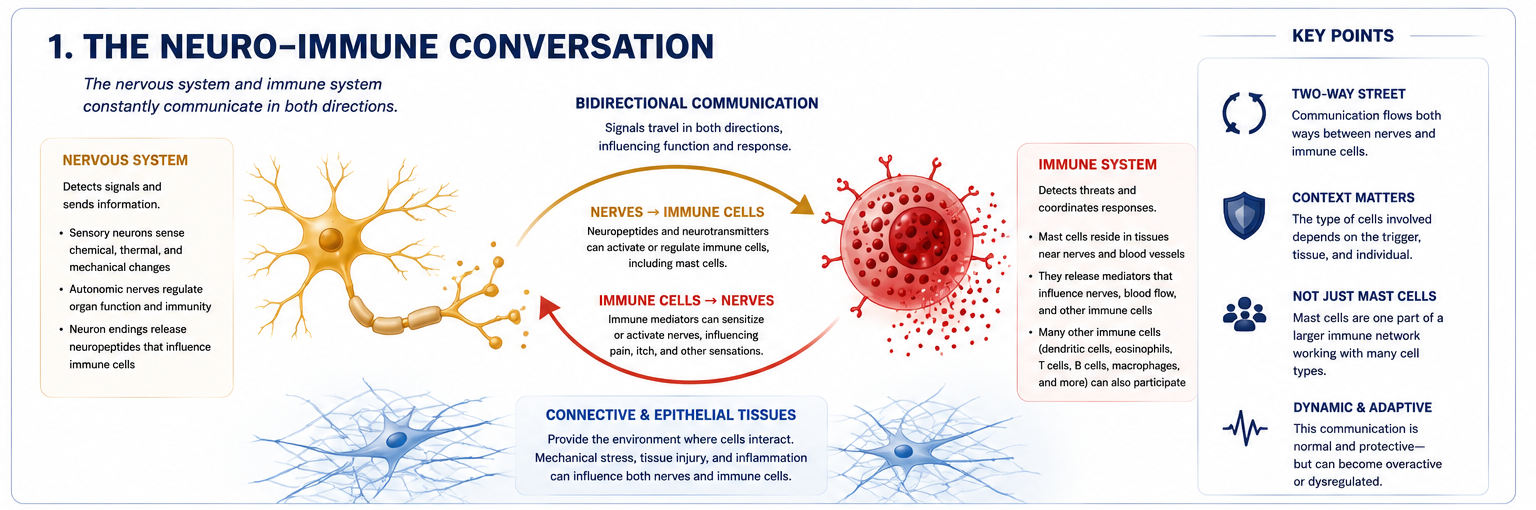
Infographic showing two-way communication between the nervous system, immune cells, and connective tissue.
Mast cells: part of the body's alarm system
Mast cells are immune cells that help the body respond to its environment.
They can respond to many different signals and release a variety of mediators that influence inflammation, blood vessels, nerves, and surrounding tissues. They are particularly abundant near environmental interfaces such as the skin, gastrointestinal tract, and respiratory system. (Bao, 2024; Gupta, 2018)
In the right situation, this is protective.
But persistent or inappropriate activation can contribute to symptoms involving multiple tissues, depending on the underlying condition and context.
Importantly, mast cells are not the immune system by themselves.
They are one component of a much larger immune network. Other immune cells—including dendritic cells, eosinophils, macrophages, neutrophils, T cells, and B cells—can participate in immune responses, along with epithelial, vascular, connective-tissue, and nervous-system cells. (Bao, 2024; Matatia, 2024)
This broader perspective is important because it keeps us from looking for one “culprit” cell.
The interesting question is how these different cells and systems communicate.
Nerves don't just carry pain
We often think of nerves as electrical wires that carry information from the body to the brain.
They're much more complicated than that.
Sensory nerves communicate information about temperature, pressure, chemical signals, and tissue irritation. They also communicate back to tissues and immune cells.
This means that nervous-system activity can influence immune signaling—and immune signaling can influence nerves.
Research increasingly supports this bidirectional communication. Mast cells can influence sensory nerves, while activated sensory nerves can also influence nearby mast cells. (Gupta, 2018; Bao, 2024)
When nerves become sensitized, relatively ordinary stimuli can sometimes produce disproportionately strong sensations.
This can contribute to experiences such as pain, itching, sensory sensitivity, headache, or other symptoms.
Connective tissue is more than structural support
Connective tissue provides the framework that holds the body together.
But it is also biologically active.
Connective tissues contain nerves, blood vessels, immune cells, and other cells that constantly communicate with their surrounding environment.
Mechanical forces, tissue tension, inflammation, and changes in the extracellular environment can all influence these interactions.
This becomes particularly interesting in people with hypermobility or connective-tissue disorders, where mechanical stress and tissue stability may influence symptoms throughout the body.
The important part is the conversation
The most important concept isn't any one of these systems by itself.
It's the cross-talk between them.
Imagine three people in a conversation.
One becomes increasingly agitated.
That changes the behavior of the second person.
The second person responds in a way that further aggravates the first.
Now the third person reacts to both of them.
Eventually, everyone is responding to everyone else.
The body can behave similarly.
Immune signaling can influence nerves.
Nervous-system signaling can influence immune cells.
Mechanical changes in connective tissue can influence both.
The result can become a self-reinforcing cycle.
Research on mast cells and sensory nerves provides a particularly clear example of this concept: both cell types can influence one another, potentially contributing to feedback loops involved in inflammation, pain, and itch. (Gupta, 2018; Bao, 2024)
Why symptoms can spread across the body
This helps explain why chronic illness doesn't always stay in the organ where it seemed to begin.
A persistent problem in one part of the system can create downstream effects elsewhere.
For example, ongoing physiological stress may affect sleep.
Poor sleep can reduce recovery.
Reduced recovery can decrease exercise tolerance.
Reduced activity can affect conditioning and autonomic function.
Changes in autonomic function can contribute to dizziness or heart-rate symptoms.
At the same time, gastrointestinal dysfunction, immune activation, or pain can add additional stress to the system.
None of these necessarily means that one problem directly “caused” every other symptom.
Rather, the systems can interact and amplify one another.
This is why patterns matter
Instead of asking only:
“What causes this symptom?”
we can also ask:
“What else happens at the same time?”
Does the symptom flare after poor sleep?
After exertion?
During periods of stress?
With certain foods?
With heat?
When pain increases?
When gastrointestinal symptoms worsen?
When you are fighting an infection?
Patterns like these can provide important clinical information.
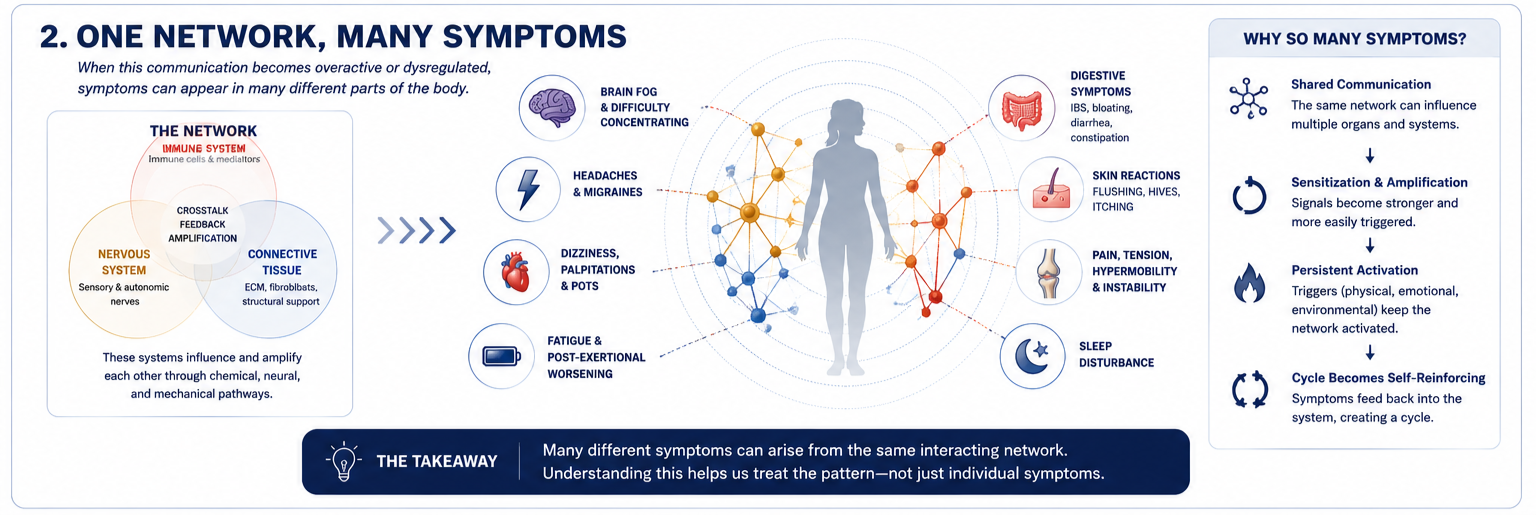
Infographic showing how interconnected immune, nervous, and connective tissue systems can contribute to multiple chronic illness symptoms.
The goal is to interrupt the cycle
If multiple symptoms are being generated or amplified by interacting systems, treating each symptom independently may not be enough.
The goal becomes identifying the factors that are maintaining the cycle and gradually restoring regulation.
That is one reason a systems-based approach often emphasizes stabilization before more aggressive intervention.
The objective isn't to suppress every symptom as quickly as possible.
It is to understand the network well enough to determine where intervention is most likely to help—and least likely to make the system more reactive.
Your symptoms may look unrelated.
Biologically, they may not be.
Want to go deeper?
This article intentionally stays at the level of systems rather than individual cytokines or molecular pathways. For readers who want to explore the science further, these reviews are useful starting points.
References
Bao C, Abraham SN. Mast cell-sensory neuron crosstalk in allergic diseases. J Allergy Clin Immunol.2024;153(4):939-953. doi:10.1016/j.jaci.2024.02.005.
Gupta K, Harvima IT. Mast cell-neural interactions contribute to pain and itch. Immunol Rev. 2018;282(1):168-187. doi:10.1111/imr.12622.
Matatia PR, Christian E, Sokol CL. Sensory sentinels: neuroimmune detection and food allergy. Immunol Rev.2024;326(1):83-101. doi:10.1111/imr.13375.
Mittal A, Sagi V, Gupta M, Gupta K. Mast cell neural interactions in health and disease. Front Cell Neurosci.2019;13:110. doi:10.3389/fncel.2019.00110.
Green DP, Limjunyawong N, Gourley M, et al. A mast-cell-specific receptor mediates neurogenic inflammation and pain. Neuron. 2019;101(5):832-846.e6. doi:10.1016/j.neuron.2019.01.012.