Why Treating One Symptom at a Time Doesn't Always Work
If you have a chronic illness with many symptoms, you've probably become very good at symptom management.
Something for the headache.
Something for the stomach.
Something for sleep.
Something for the allergies.
Something for the pain.
Something for the dizziness.
Sometimes these treatments are helpful—and symptom relief absolutely matters.
But there is another question worth asking:
Why are so many symptoms happening in the first place?
The symptom is not always the whole problem
Think about your body's warning lights.
If the check-engine light comes on, you can cover the light with tape.
The light disappears.
But the engine problem doesn't.
Symptoms are similar.
They are often information about what is happening within the body.
Suppressing a symptom can be useful and appropriate, but symptom relief doesn't necessarily tell us whether the underlying physiological problem has changed.
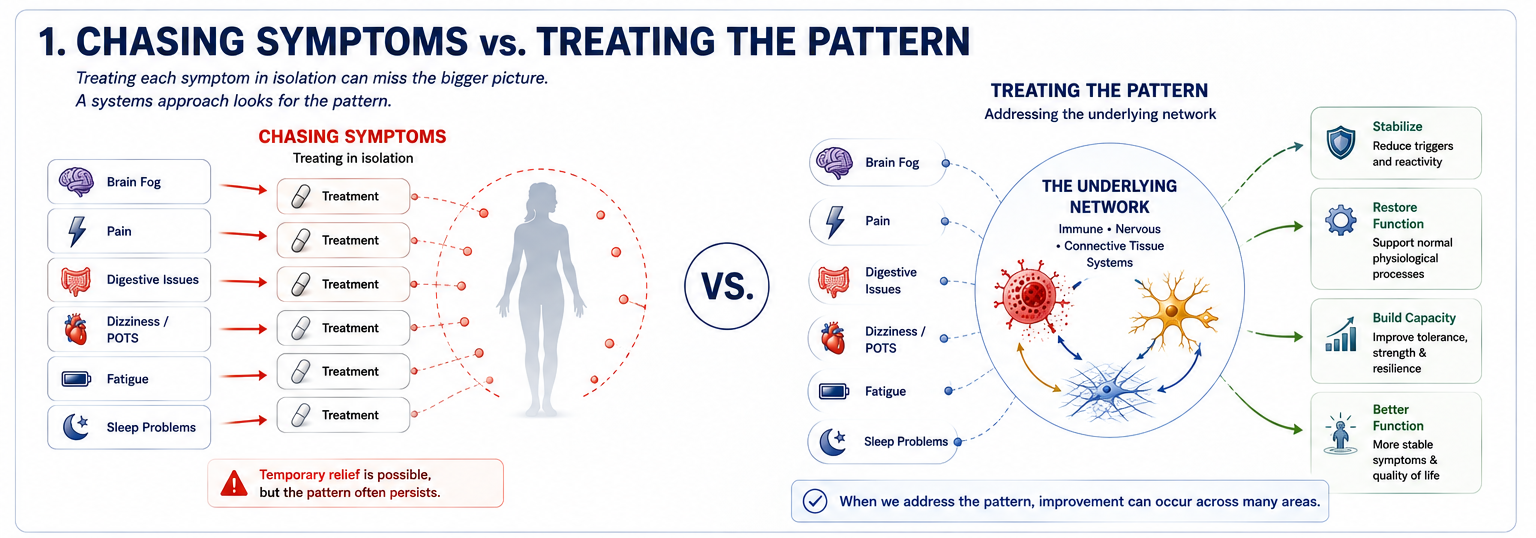
Infographic comparing symptom-by-symptom treatment with a systems-based approach to chronic illness.
One patient can have many “diagnoses”
Complex chronic illness often doesn't fit neatly into one category.
A person may have gastrointestinal symptoms, migraine, chronic pain, dysautonomia, hypermobility, fatigue, and unusual sensitivity to environmental or dietary triggers.
Each problem may have its own diagnostic label.
But that doesn't necessarily mean the problems are completely independent.
Sometimes several conditions coexist because they share overlapping biological pathways.
This is where a systems-based approach becomes useful.
Think upstream
Imagine a tree.
Symptoms are the leaves.
Treating individual symptoms is like trimming individual leaves.
Sometimes that's exactly what you need to do.
But if the leaves keep growing back—or more leaves keep appearing—it may be worth examining the branches, trunk, and roots.
In medicine, “upstream” doesn't necessarily mean finding one magical root cause.
It means looking for factors that may be driving or amplifying multiple downstream problems.
What keeps the system activated?
The answer will be different for every person.
Potential contributors can include things such as:
ongoing physiological stress
inadequate recovery
sleep disruption
overexertion
nutritional problems
gastrointestinal dysfunction
environmental exposures
infections
mechanical stress
autonomic dysfunction
immune dysregulation
Some of these may be relevant.
Some may not.
The clinical task is to determine which ones actually fit the person's history and examination rather than assuming that every possible factor is contributing.
Why “more treatment” isn't always better
This is particularly important in people with complex or highly reactive illness.
When someone isn't improving, the natural response can be to add another intervention.
Then another.
Then another.
Eventually, the person may have a long list of treatments but very little understanding of which ones are actually helping.
And in a highly sensitive patient, changing too many things at once can make it difficult to determine what caused an improvement—or a flare.
A systems-based approach therefore values sequencing.
First, establish stability.
Then restore physiological function.
Then gradually increase the body's capacity and resilience.
The exact interventions depend on the person.
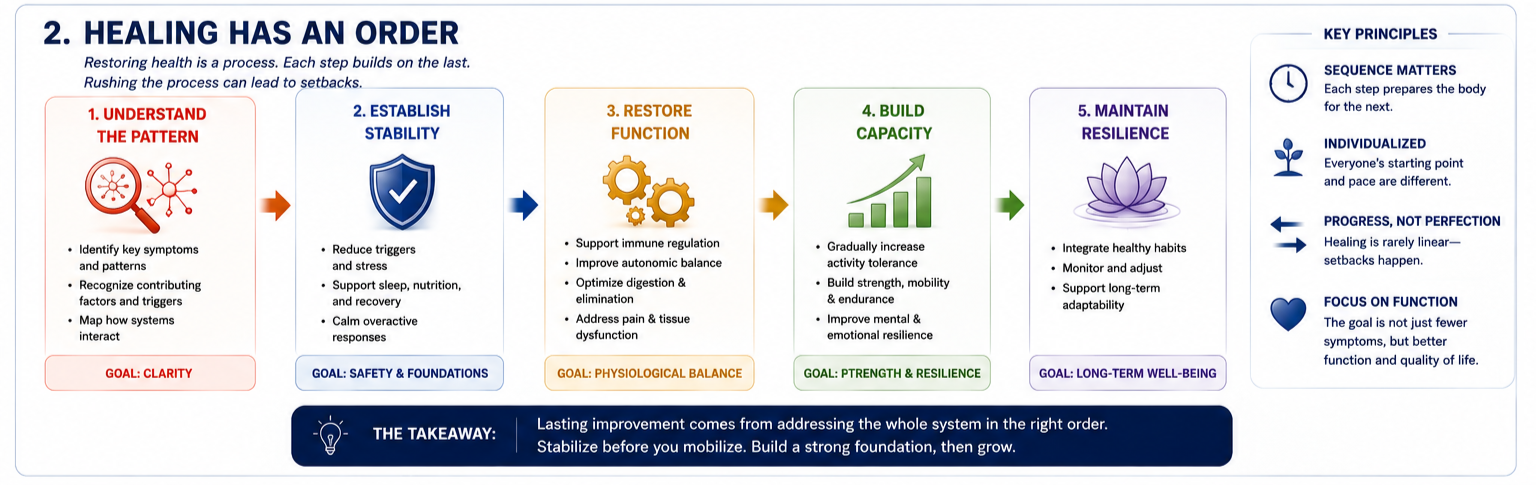
Infographic showing a five-step systems-based approach to chronic illness treatment, from understanding symptoms and establishing stability to restoring function and building resilience.
Stabilize before you mobilize
One of the central principles of this approach is simple:
Stabilize before you mobilize.
If the system is already highly reactive, aggressively pushing it may produce more symptoms rather than better function.
That doesn't mean doing nothing.
It means choosing the appropriate starting point.
For one person, that may mean improving sleep and recovery.
For another, addressing gastrointestinal function may be more important.
For someone else, autonomic regulation or activity pacing may need to come first.
The order is individualized.
The goal is ultimately function
The purpose of treating a complex chronic illness isn't simply to create a longer list of things the patient can tolerate.
It's to help the person function better.
That may mean fewer flares.
Better sleep.
Greater exercise tolerance.
Improved digestion.
Less pain.
More stable autonomic function.
Better concentration.
Or simply being able to participate in everyday life again.
Those improvements may occur gradually.
And they may not happen in a perfectly straight line.
A better question
Instead of asking only:
“What can we give this symptom?”
a systems-based approach asks:
“Why is this symptom occurring?”
Then:
“What else is happening in the system?”
And finally:
“What is the safest and most useful place to intervene first?”
That's the difference between chasing symptoms and treating the system that produces them.
The goal isn't to ignore symptoms.
It's to listen to them.
Want to go deeper?
This article is intentionally focused on clinical reasoning rather than specific treatments. For readers interested in the science behind the interactions between immune cells, sensory nerves, and chronic symptoms, the following articles provide additional background.
References
Gupta K, Harvima IT. Mast cell-neural interactions contribute to pain and itch. Immunol Rev. 2018;282(1):168-187. doi:10.1111/imr.12622.
Bao C, Abraham SN. Mast cell-sensory neuron crosstalk in allergic diseases. J Allergy Clin Immunol.2024;153(4):939-953. doi:10.1016/j.jaci.2024.02.005.
Mittal A, Sagi V, Gupta M, Gupta K. Mast cell neural interactions in health and disease. Front Cell Neurosci.2019;13:110. doi:10.3389/fncel.2019.00110.
Hamilton MJ. Mast Cell Activation Syndrome and Gut Dysfunction: Diagnosis and Management. Curr Gastroenterol Rep. 2024;26:107-114.
Bradding P, Pejler G. The controversial role of mast cells in fibrosis. Immunol Rev. 2018;282(1):198-231. doi:10.1111/imr.12626.